Showing posts with label hand knitting. Show all posts

Saturday, December 19, 2015

How to Knit a V-Neck


To start the neck, place the center-stitch of the front of the sweater on a holder.

To figure the spacing of the decreases: Take the number of rows in which you need to decrease (gauge × length-of-V) and divide that number by the number of decreases needed to make the number of front shoulder stitches the same as the number of back shoulder stitches. This will determine how many rows you need to work between decreases.

Work the decreases on right side rows only. Work the decrease as evenly as possible in the 2nd or 3rd stitches from the edge, never in the edge stitch.

Example: To work simple V-neck Shaping (decreasing every right side row)

1. Work to the center point and place a marker on the last wrong-side (purl side) row before beginning the neck shaping. Work the rest of the row.

2. (right side, knit side) Work to four stitches before the marker, work two stitches together for a right leaning decrease (k2tog) and then work to the marker. Leave remaining front stitches on a holder (These will be the left front of the V). Turn the work and work to the end of the row (wrong side, purl side). Repeat these two rows until the v-neck is the desired depth and front shoulder stitches the same as the number of back shoulder stitches.

3. Join yarn on the right side at the center front and work the other side of the v-neck (left front) by working two stitches, then work two stitches together for a left leaning decrease (ssk, or sl 1, k1, psso) work to the end of the row and turn the work. Work to the end of the row (wrong side, purl side). Repeat these two rows until the side shaping matches the other side (front right v-neck).

When working neck-band: Using a circular needle, pick up sts evenly around the neck. Work to one stitch before the center-stitch, slip 2 sts together as if to knit, k1, and pass the 2 slipped sts over the knit-stitch (s2kpsso). (This makes the center-stitch lay on top.) Do this every row for 1 or 1-1/2 inches; bind off loosely.


(s2kpsso)

This video shows you how to make this decrease (wait to the end!)


Saturday, September 28, 2013

An easy way to increase stitches evenly

One thing that you will find in patterns very often are directions to increase stitches evenly across a row.  The directions might say "inc 21 sts evenly" or "inc evenly to 71 sts".  Doing this requires simple 4th grade math and is a lot easier than it sounds like it should be.


Thursday, September 26, 2013

Shaping a Sweater Yoke for Better Fit with Short Rows

Some of us are working on the lovely petal cardigan which I re-designed and sized up for adult sizes.  In our first class we talked about improving the fit so that the front neckline doesn't ride up uncomfortably.  This improvement in fit can be achieved with short rows.


Friday, September 6, 2013

How to Cast Onto Double Pointed Needles

I'd like to call this series the buffet sock series.  Its the first sock class I've taught and we covered a little bit of everything.  Dpns, magic loop, 2-circs, and pick your favorite ribbing.  At least we stuck to cuff down knitting.  Next time we'll go toe up.

We started at the cast on ... option 1.  Double pointed needles.  (stay tuned for the follow up videos)

Thursday, July 4, 2013

The Not So Common Lace Cast On

This is a very pretty cast on.  It is rather fussy to work, and if you hold the yarn in your left hand, it is rather awkward to work, but nonetheless, it is worth the work.  


Sunday, March 17, 2013

How to Make a Slip Loop

In my beginning knitting classes the single most difficult maneuver to get is how to make the slip loop.  I put together a short video tutorial and I hope it is helpful.  After learning how to get that first loop on the needles, everything else is really much easier!


Sunday, July 3, 2011

Color Choices For Hand Knits

There are a of variables that contribute to choosing what colors to knit with.  Your personal preferences, the intended recipients preferences, culture, tradition, what the item you're making will be used for.  So, really, there is no magic formula to the perfect color choice ... you get to make up the rules!  But, if you want a few suggestions as a starting off point.... 

Colors may convey a special meaning.  For those who want to knit an item that expresses solidarity with a specific cause, here are some colors associated with special groups.

Pink - Breast Cancer
Red  - Heart Disease, DUI Awareness (MADD), HIV/AIDS
Grey - Diabetes
Yellow - Testicular Cancer, Deployed Soldiers, Liver Cancer & Liver Disease, Bladder Cancer
Blue - Drunk Driving, Epstein-Barr
Purple - Alzheimer's Disease, Animal Abuse, Cancer Survivor, Children with Disabilities, Crohn's Disease, Cystic Fibrosis
Orange - Hunger Awareness, Leukemia, Lupus
Silver - Abuse of the Elderly
Teal - Ovarian Cancer, Sexual Violence, Spaying & Neutering Pets, Substance Abuse
White - Peace, Bone Disease & Bone Cancer, Multiple Sclerosis
Black - POW-MIA, Anti-Gang
     

Colors are also associated with specific emotions.  

Pink - this color generally represents sweetness and sensitivity, and is seen as indicative of health and vibrancy. It stands for faith and fidelity, and is a good color to demonstrate steadfast friendship.

Red - a passionate and energetic color, this color has long symbolizing energy, power and courage, and can give the wearer strength and fortitude. It also signifies romantic love.

Purple - dignified, mysterious and sophisticated, this color has long been associated with royalty and magic. It inspires awareness and sensitivity, and taps into the unconscious.

Lavender - This refined and delicate shade stands for sensual femininity. It has a genteel presence, and suggests elegance and grace.

Mauve - This noble color projects a high regard for style. Simultaneously subdued and rich, this color projects both a regal and exclusive air.

Blue - this color is associated with stability and steadfastness and often represents tranquility. It is cool and peaceful and can have calming influences.

Green - the universal color of nature, green represents growth, fertility, and health. It is also youthful and fresh, and can symbolize luck.

Yellow - calling to mind sunshine, this color is optimistic, cheerful and full of vitality. It is the most luminous color of the spectrum and is naturally eye-catching.

Orange - this color has psychological connections to excitement, warmth and energy. The color of flames and the sun, orange has inspiring and provocative qualities.

Brown - Earthy, rich and warm, this color represents comfort and durability.

White - clean, crisp and pure, this color symbolizes newness, innocence and purity. It is often used in religious ceremonies.

Grey - this color is cool and balanced, with crisp and sophisticated connotations. While lighter shades are conservative and formal, darker shades convey a sense of depth and mystery.

Sunday, May 8, 2011

Choose Your Knitting Needles Based on Your Preferences

Needles are your main tool and are a very personal choice. The type of needles you choose has a substantial effect on the finished project and as a beginning knitter on your knitting experience as a whole.  As a beginner, don't let displeasing needles spoil your knitting experience!  Each needle type feels different in your hands so it’s important to try several different types to see what your preferences are and what works best for the project you are working on.

The different Types
Knitting needles are grouped into three general types: straight, circular and double-pointed. You can read a general discussion about the uses for each of these types of needles here.

They also come in various thicknesses from 0.75mm to 25mm and you will need a variety of thickness to be able to get gauge. Gauge is important and I talk more about it here.

Manufacturers are not standardized as far as identifying thicknesses go.  A US size 8 needle in one brand will not be the same thickness as a US size 8 in another brand.  Not only do different brands vary in size, but also the material the needles are made from will affect the thickness. You will definitely need to buy a gauge card to help you sort things out. These are usually made of plastic or metal with holes punched in them that correspond to the standard metric sizes.  Generally, they will have the U.S. equivalent for each size printed on the card and often the U.K. equivalent as well.

The different Materials

Needles are made of several types of materials including aluminum, nickel-plated aluminum, bamboo, birch, walnut, ebony, casein (a milk protein), and various plastics.

Here is the good and the bad on several different materials:

Wood
The Good: They are lightweight, quiet, feel warm in your hands; have slightly rough surface which grips the yarn when knitting so you work more slowly and have more control over the stitches.  This is good for beginners or advanced knitters working on complex patterns.
The Bad: Availability can be limited and they can be expensive. They may break or splinter; some people don't like the slow knitting.

Bamboo
The Good: These are also lightweight and quiet; they feel warm in your hands and they are easily available in most shops and they are reasonably inexpensive; surface grip can also slow your knitting speed, but this can depend on the brand.
The Bad: Like other wood needles, these can break or splinter at the tips, and some people don't like the added surface grip that can slow down your knitting.

Aluminum
The Good: Easily available in most craft shops; can be very inexpensive; smooth, they have a slick surface that allows you to knit very quickly with minimum resistance.
The Bad: They may make a clicking sound while you knit which can be annoying for some people; surface can scratch and the color can fade over time; the metal can feel cold and they are rather inflexible, some knitters (particularly those with arthritis or carpal-tunnel syndrome) might find them uncomfortable.

Nickel and nickel-plated aluminum
The Good: The nickel plating makes the surface even smoother than aluminum, which equals speedy or slippery knitting; they are very lightweight.
The Bad: Depending on the brand, they can be expensive; like other metal needles, they can make noise while knitting; and, the rigidness of the metal can be annoying for people with arthritis or sensitive hands.

Swallow Casein
The Good: These are made of a natural milk protein; they are available in a wide range of colors; they feel warm in your hands; their surface is smoother than wood but not as slippery as aluminum; they bend and flex and are generally very quiet while knitting.
The Bad: Although these needles are made from organic materials, Swallow casein needles can look and feel artificial; also, because they are only manufactured by one company, availability can be limited.

Balene
The Good: These very flexible knitting needles are made of milk protein and are ideal for knitters with arthritis; they are warm and smooth to the touch.  They have concave points and many knitters really love them.
The Bad: Some people find the plastic texture too flimsy; their availability is very limited, so you may have to order online.

Bryspun
The Good: Bryspun flexible knitting needles are made of a special plastic and are very popular for knitters with arthritis; they are warm and smooth to the touch.
The Bad: Many people find the plastic texture too flimsy; their availability is very limited, so you may have to order online.

Pony Pearls
The Good: These are made of cellulose acetate and come in a wide variety colors.  They have a fairly smooth surface for quick knitting.
The Bad: Sizes 0-8 are reinforced with steel wire, which can rattle around inside the needle while you're knitting and this can be distracting plus the wire adds extra weight to the needles.  Also, although these are cellulose, they aren't as flexible as Bryspun or Balene needles. 


You may think that you'll only need one pair of needles in each size. But, truthfully, you can never have too many duplicate sets of needles. Needles do get lost, and if you like to work on more than one project at a time you'll need plenty of needles standing by.

Sunday, May 1, 2011

Six Steps To Designing Your Own Handknits

Just because you're a beginning knitter doesn't mean you can't design your own hand knits.  Here are six steps to help you get started:

1. Make a swatch
The swatch is a sample of the fabric you'll be creating.  Swatching is your friend!  You'll swatch for gauge, of course, but also:
  • To test out stitch and color ideas.
  • To check how different stitch patterns work together.
  • To try out different cast-ons and bind-offs.
  • To see how different needles affect the fabric you are knitting.
2. Try out different yarns
You may have some ideas about which yarns will work with the stitch patterns you have in mind, but nothing is more revealing than actually knitting a sample of your stitch patterns with different yarns.  You'll discover that different stitch patterns result in different widths over the same number of stitches and that this will also vary with different fibers - even if the yarns are the same weight category.  Its best to have an idea of what to expect in advance.
3. Measure an existing garment that you really like
Base your dimensions for your design on a similar knitted garment that fits the way you like.  
4. Give in to your knitting preferences
There is no sense in torturing yourself by working with techniques you don't like.  If knitting on size 3 needles and fingering weight yarn makes you cringe, then use bigger needles and thicker yarn!  If you hate seams, knit in the round.  But, if you crave intricate details, love beading, go gaga over cables and really complex lace ... then, knock yourself out, its your knitting after all.
5. Do the math
Ok, so I'm not a fan of math and numbers make my brain feel all melty, but unless you love ripping and re-knitting, you'll want to check your math before you start.  Ideally, you'll want to do the actual knitting as few times as possible, you know, just the one time.
So figure your gauge. Take your measurements. Grab your calculator and do the math. Work out how many stitches to cast-on and where to increase and decrease. Have a bit of faith and start knitting.
6. Write it all down
Even if you're not planning on drafting out a full pattern of your design, give yourself a break and write stuff down!  That way you won't have to agonize over which row you started your shaping or any other tweaks you made as you've been working your design. 

Friday, April 1, 2011

What's all That Knitting Speak Mean?!

When you're just starting out learning to knit some of the language can be confusing!  Here is a list of common terms to help you out:
  • Bind Off In Pattern
    Generally this instruction is given when you have been knitting using a
     stitch pattern. Work the bind off row in the same stitch pattern that you were knitting, binding off the knit stitches knitwise and purl stitches purlwise.  Even if the directions don't specifically tell you to bind off in pattern, you should do so, this is a small detail but adds a professional touch. 
  • Decrease Or Increase Evenly
    Sometimes a pattern will tell you where to decrease or increase across a row; other times it will only tell you the number of stitches to decrease or increase and to do so evenly.  This just means to space your increases or decreases across your row instead of placing them close together.  If they're spaced too close together, it can cause
     your knitting to pucker and flare. 
  • Keeping To Pattern (Or Work as Established, Or Maintain Pattern)
    If you knitting a
     stitch pattern, you'll just follow the instruction for each row as long as you keep working over the same number of stitches. If there is shaping involved, like on a sleeve or neckline, you will need to pay attention to how the increases or decreases affect the stitch pattern.
  • Multiple Of Stitches
    A stitch multiple is the number of stitches you need to have for one complete repeat of a stitch pattern. A multiple of 5 stitches means you should cast on any number of stitches that is divisible by 5. A multiple of 6 + 1 means you should cast on any number of stitches that is divisible by 6 plus 1 extra stitch.  The extra stitches are sometimes border stitches, or necessary to balance the stitch pattern within the overall design.  Knowing the multiple of the stitch pattern you are working with is very helpful, especially if you are modifying the size of the project you are working on.
  • Reverse Shaping
    Almost all cardigan patterns will give you complete instructions for knitting one front and then tell you to work the other front to correspond reversing all shaping. It's cruel, I know, but we can persevere.  Basically, what you are doing is mirror imaging the shaping instructions.  Graph paper is very helpful when you're working this out. 
  • Selvedge
    You will also see this word spelled selvage. All flat knitting has a selvedge on each side. It only means the first and last stitches. If it's something that will be seamed, these are the stitches that will be used to seam the piece together.  Your selvedge stitches can be decorative if they are not going to be incorporated into a seam.  
  • With Right Side Facing
    This means to have the outside, or public side of the fabric facing YOU.  Often this direction is given when you are about to pick up stitches along an edge but you may see it at other times too. 
  • Work Even
    You'll often see this term following a sequence where you just completed increasing or decreasing.  It just means that you will continue working over the next section without any more increasing or decreasing.  

And we also have these terms that were originally used by knitters on the internet, but now have become common knitting language:
CAL
Crochet-A-Long. See KAL
FO
Finished Object.
Frog, Frogging
To undo knitting to go back to correct a mistake by removing the needles and ripping the stitches out. From the sound a frog makes - ribbit ribbit sounds like rip it, rip it. See tink.
Frog pond
To remove the needles and undo knitting all the way. To recycle the wool from a half knitted project to use in a different project. eg: I've sent the sock that didn't fit to the frog pond and I'm going to make a scarf from the wool.
Halfpint
Have A Lovely Fantasy Project. I've No Time.
KAL
Knit-A-Long. See CAL
LYS
Local Yarn Store.
OTN
On The Needles. A current knitting project.
SSS
Second Sock Syndrome. After having finished one sock it becomes dificult to go on and finish the second one to make a pair.
Tink, Tinking
To undo knitting to go back to correct a mistake stitch by stitch. Tink is knit spelt backwards. See frog.
UFO
UnFinished Object
WIP
Work In Progress

Sunday, March 20, 2011

Mixing It Up Some More ... Easy Knit, Purl Combinations

So when you've gotten to the point that you can easily recognize a knit stitch or purl stitch, then its time to try some more knit purl combinations.  There are thousands of stitch patterns to try out and going through pattern stitch collections will provide plenty of inspiration.

Barbara Walkers collection of stitch dictionaries are a great resource when you want to start practicing different stitch patterns.


If you are very visual, you might want to take a look at:

Here you will find lots of colorful pictures of the different stitch patterns in this dictionary and a pretty good explanation of chart reading.


If you are eager to try a simple knit, purl stitch combination, here is an easy basket weave baby blanket pattern for you to start with:


Finished Measurements:
Approximately 24 ½ x 27 ½

Materials:
  600 yards worsted weight yarn
  One 29 “ long size 8 circular needle 
  Stitch Markers
  Row counter
Note:  You will be working flat, the circular needle is used to accommodate the larger number of stitches

Gauge:
In basket weave pattern, using size 8 needles:
19 stitches and 32 rows = 4”

Pattern Stitches:

Seed Stitch (multiple of 2)

Row 1:  (RS) *k1, p1; rep from * to end.
Row 2:  knit the purl sts and purl the knit sts.

Repeat row 2 for seed stitch pattern.

Basket Weave (multiple of 8 + 2)

Row 1:  (WS) Purl.
Row 2:  k2, *p6, k2; rep from * to end.
Row 3:  p2, *k6, p2; rep from * to end.
Row 4:  Repeat row 2.
Row 5:  (WS) Purl.
Row 6:  p4, *k2, p6; rep from * to end.
Row 7:  k4, *p2, k6; rep from * to end.
Row 8:  Repeat row 6.

Repeat rows 1-8 for basket weave pattern.

Abbreviations:
k = knit     p = purl     rep = repeat     sts = stitches     WS = wrong side     RS = right side    

  
Directions:

Bottom Border:
Cast on 116 sts.  Do NOT join, work back and forth on circular needle in seed stitch for 2”.

Blanket Body:
(WS) Work in seed stitch across 9 sts, place marker, work row 1 of basket weave pattern over next 98 sts, place marker, work in seed stitch across last 9 sts.  Keeping first 9 sts and last 9 sts in seed stitch pattern, repeat rows 1 – 8 of basket weave pattern over center 98 sts until piece measures 25 ½” from the beginning, finishing with row 5 of basket weave pattern.  Do NOT bind off.

Top Border:
(RS) Work in seed stitch across all sts, removing markers.  Continue in seed stitch until top border measures 2”.  Bind off in pattern.

Sunday, March 13, 2011

One Stitch - Two Stitch, Or, I can't tell what's what!

After you've learned to knit and purl the next step is to combine these stitches within the same row.  One of the most common stitch patterns combing knit and purl stitches is ribbing.  I my classes, the point of making fabric in a ribbing pattern is to learn to see the stitches.  When you are first starting out, seeing which are the knits and which are the purls can be confusing.  Also, when you are making ribbing, you're often told to knit the knits and purl the purls.  This is so you don't have to think about what comes next in the stitch pattern, just see what is on your needles - if its a knit, knit it, if its a purl, purl it.

This image of knit 1, purl 1 ribbing shows how the knit stitches resemble a letter V and are sitting vertically at the base of the needle, while the purl stitches look like a bar, or dash lying horizontally across the base of  the needle.


Notice the loose stitch at the beginning of the row ... it is a purl stitch.  Watch out for that guy, he often tries to roll over the top of the needle and pretends to be two stitches.  If you don't see the stitches you could easily fall for this and unknowingly add extra stitches you don't want.

Being able to see the stitches is critical when it comes to recognizing when things aren't going right and also to finishing your knits.  Seeing which are the knits and purls is really helpful when you are weaving in your ends and when you are seaming.


Sunday, March 6, 2011

Pretty Edges, Pretty Easy

I covered several variations of the chain selvedge in a previous post.  You can read it here:  Wonky Edges.

I'd like to offer a few options for decorative selvedges.  Try them out and see how you well you like them.

1.  Garter Stitch Selvedge:  (version 1)  knit the first and last stitch of every row.
    
2.  Garter Stitch Selvedge:  (version 2)  Right side:  Purl the first stitch and knit the last stitch.  Wrong side:  Knit the first stitch and purl the last stitch.

3.  Double Garter Stitch Selvedge:  Knit the first two and last two stitches of every row.

4.  Penultimate Garter Stitch Selvedge:  Right side:  Purl the first stitch, knit the second stitch, work to the last two stitches, knit the next to the last stitch, purl the last stitch.  Wrong side:  Knit the first two and last two stitches.

5.  Penultimate Chain Stitch Selvedge:  Right side:  slip the first stitch as if to knit, purl the next stitch, work to the last two stitches, purl the next to the last stitch, knit the last stitch.  Wrong side:  slip the first stitch as if to purl, knit the next stitch, work to the last two stitches, knit the next to the last stitch, purl the last stitch.

6.  Seed Stitch Selvedge:  Knit the first stitch, purl the second stitch, work to the last two stitches, purl the next to the last stitch, knit the last stitch.  Repeat every row.

There are probably many more variations for decorative edges, you can even make up some of your own!

Sunday, February 27, 2011

Hey, why do the edges of my knitting look all wonky?!

Sometimes you'll notice that the edges of your knitting will look wobbly and wonky.  Not neat and even.  What to do to make sure your edges stay even, well, work a selvedge.

There are several selvedge edges but the most common are the chain selvedges.  These are the four variations:

1.  slip the first stitch of as if to knit on the right side rows, slip the first stitch as if to purl on the wrong side rows.

2.  slip the first stitch and last stitch as if to knit on right side rows, purl the first and last stitch on wrong side rows.

3.  slip the first stitch as if to knit and the last stitch as if to purl on the right side rows, knit the first stitch and purl the last stitch on wrong side rows.

4.  knit the first stitch and slip the last stitch as if to purl on every row.

To slip a stitch as if to knit insert the right needle into the first stitch as if you were going to knit it keeping the working yarn to the back of the work and slide the stitch from the left needle to the right needle without actually knitting it. This is also described as slipping a stitch knitwise. 

To slip a stitch as if to purl insert the right needle into the first stitch as if you were going to purl it keeping the working yarn to the front of the work and slide the stitch from the left needle to the right needle without actually purling it.  This is also described as slipping a stitch purlwise.

My favorite chain selvedge is version 4 because I don't have to remember if I am on a right or wrong side row and it produces a very even chain along both edges of the knitting.  Plus, it looks very pretty on garter stitch fabric.  Try each one for yourself and see which one you like best.


Tuesday, February 15, 2011

Preventing Pain and Strain While Knitting

Once you get into knitting, it might seem like you never want to do anything else and find yourself knitting for hours on end.  What we love can hurt us.  Yep, it can happen.  Fortunately, just as with any physical activity, a little stretching can help a lot.  Here are some exercises from the makers of Handeze Gloves. I do these and they're really helpful.  Stretch before you start knitting, take a break while you're knitting and stretch again.  When you put your knitting away, guess what, stretch again.  You'll be glad you did.

Hand Massage: With the thumb of the left hand, massage the palm of the right hand.  At the same time, wrap the fingers of the left hand round the outside of the right hand and massage. Massage for one minute. Repeat with opposite hand. 

 Clench and Fan: Clench your hand into a tight fist and hold for five seconds. Release smoothly, extending the thumb and fingers into a fully stretched position and hold for five seconds. Repeat five times for each hand.

Thumb Stretch: With the left hand, gently pull the thumb of the right hand away from the thumb and down toward the forearm. Hold for five seconds. You should feel the stretch in the base of the thumb, palm side. Repeat for the left thumb. Five repetitions, alternate thumbs.


Wrist Stretch: Hold the right hand in front of the body, palm facing out, fingertips up, fingers together. With the left hand, grasp the right hand's outstretched fingers and gently pull the fingers back toward the body. Hold for five seconds. You should feel the stretch in   the wrist area. Repeat for the left wrist. Five repetitions, alternative wrists.


Wrist Circles: With hands in front of the body and elbows held at a comfortable angle, gently rotate the wrists. Five repetitions in each direction. Good work! Now you're ready to knit in comfort!


Sunday, January 30, 2011

A Guide to Translating Yarn Labels

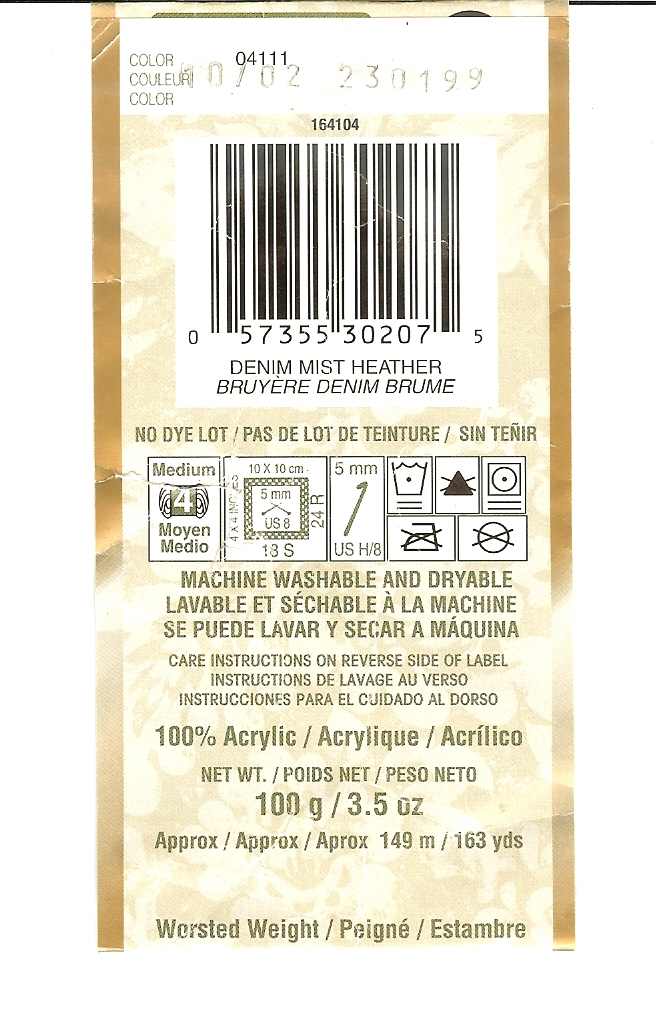
A couple of weeks back, one of the main topics in class was reading a yarn label.  Here is a rundown of  the discussion.

It doesn’t matter how your yarn is packaged, it could be in a neat little ball, a pull-skein, or in a hank. It will come with a label that gives you valuable information about the yarn.

Yarn labels will include most, if not all, of the following information:


Article number: This is a code that the manufacturer uses to keep track of different products, but it isn't always listed a yarn label.


Brand name: This is the name of the yarn. In the case of this example, "Satin."


Care instructions: Most labels will use the international care symbols.  For this label:
               
 Machine Wash, Cold

 Do Not Bleach

 Tumble Dry, Normal, Low Heat


Do Not Iron


Do Not Dryclean


Color name and number: A particular yarn color is given a name or a number (or sometimes both). Here we have color #04111, “Denim Mist Heather.”


Company name and logo: The manufacturer's name and logo will be prominently displayed on the label. This is not the name of the Yarn! The manufacturer of this yarn is Bernat.


Dye lot number: The lot number indicates that all the yarns that have the same number were dyed in the same the batch. Make sure sure to purchase yarn from the same dye lot so it will all be the same shade.  Some yarns do not have a lot number, ususually 100% acrylic, as in the case of our example here.


Gauge: The suggested gauge, or number of stitches that fit in 4 inches, is also given on the label. In our example the knitting gauge is 18 stitches = 4 inches, and 24 rows = 4 inches. Usually there will be a recommended hook size for crochet, but not typically a crochet gauge, which is very different from knitting.  In our example the recommended hook size is USH/8.


Manufacturer's address: Sometimes the yarn manufacturer's address is provided, which can be helpful if you want more of their yarn and are having a hard time finding it.  Also, it is becoming common to list the manufacturer's web site where you will commonly find more information about the yarn, other yarns offered by the manufacturer and even free patterns using their yarns. 


Ply: Some yarn labels will provide ply information, such as 2 ply, 4 ply, or 12 ply, which means the number of strands that are twisted together to create the yarn. This does not refer to the thickness of the yarn, you can have a thin yarn with many plies.


Weight: The physical weight of the ball or skein of yarn will be listed. This may be in grams or ounces or both.


Yardage: The length of the yarn will be given in yards and/or meters. Don't buy by weight only. Different types of yarn, even at the same thickness, contain different yards per gram or ounce. 


Fiber content: Our example is “100% acrylic”, but you may see  "100% merino wool" or blends such as "85% wook, 20% acrylic."


Yarn-weight symbol: Many yarn companies are beginning to include this symbol, as are some patterns. In our label it is:

The yarn weight symbol is designed to standardize the yarn industry and is helpful when substituting yarns.  Keep in mind, though, that yarn weight is not the only factor you should consider when substituting yarns